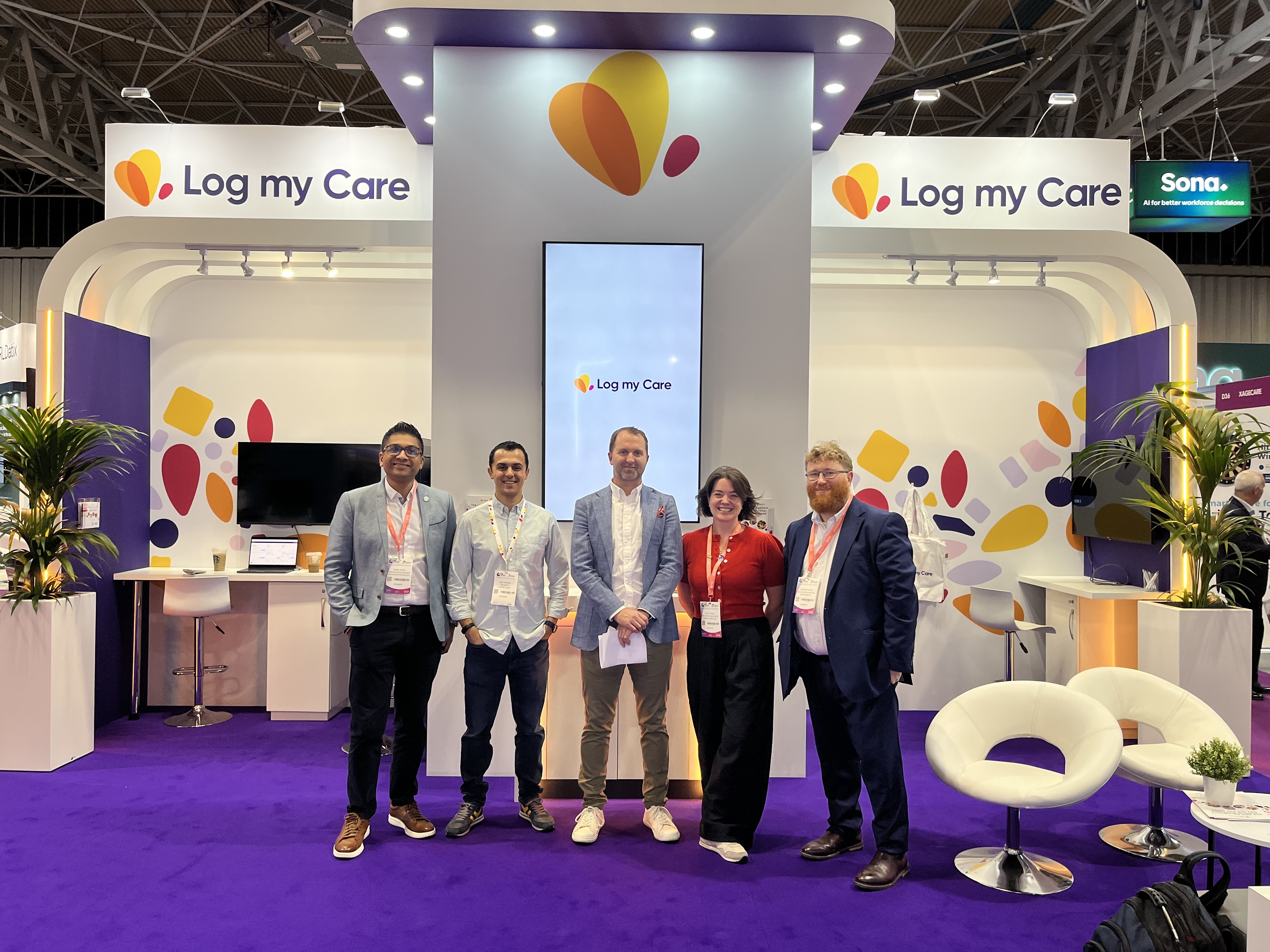
We're just back from an epic few days in Birmingham for the Care Show, where we had panel of brilliant minds discussing what AI should, and shouldn't do for your service. Ultimately, AI belongs in your service when it improves outcomes for the people you support, and only when a human stays in charge of the decisions that matter.
Most AI conversations in social care start with capability and end with hype. We wanted this conversation to start with outcomes. For years, care teams have recorded detailed information every shift and had very little of it come back to them in a form they could use. AI's job is to close that gap.
Matt Russell, our CEO, chaired the session with four people who think about this every day:
- Katie Thorn, Director of Innovation at the Digital Care Hub and co-founder of the AI in Social Care Alliance
- Vishal Shah, founder of Banyan Care, Board Trustee at Care England and Board Advisor to Log my Care
- Garmon Davies, Systems Continuous Improvement Lead at Shaftesbury
- Sam Hussain, Founder Director of Log my Care
Here are some of the key takeaways...
AI is already in your service
AI is in every care service now, whether leaders have chosen it or not. Staff use it on their phones. Competitors use it to work more efficiently. So which is the bigger risk, adopting or waiting?
Vishal's answer was that waiting isn't really an option, because the question has moved on. New research from Care England, the Institute for Ethics in AI at the University of Oxford, Serene Care and the Digital Care Hub, AI has arrived in social care, found care leaders already using AI for care planning, analysing care notes, medication management, recruitment and falls prevention. Most had received no formal training in adopting it. Much of it sits inside the software providers already use.
Therefore, the gap that needs closing is readiness. Tools can be adopted in an afternoon. Training, policy and governance take longer, and that's where providers can be left exposed.
"The one thing that's for sure is that AI is going to be there no matter what. The gap now is making sure we're ready for it, with the right training and governance in place to adopt it appropriately." - Vishal Shah
Matt shared what our own customer advisory board told us the week before: responses ranged from "I'm scared of AI and don't want to go anywhere near it" to "it's fully embedded in my service". Every organisation is somewhere on that journey, and every position on it is reasonable. What providers need to do now, is to form an understanding of where they currently stand on that journey, and the factors that are holding them from moving forwards.
Where the human takes over
Matt called this the most important question of the session, and it's the one providers ask us most often. If AI can spot a change in someone's condition, summarise their notes or flag a risk, where does its role end and a person's begin?
Katie said up front that she'd take a hard stance, and that some of the panel might disagree. AI as it stands today can carry bias, and it can produce answers that sound right and aren't. Her guidance here is clear: whenever an AI output will directly affect the care someone receives, or the working conditions of the staff delivering it, a person makes the decision.
"A human always needs to be involved, so that they are accountable and responsible for that decision." - Katie Thorn
Accountability is the heart of it. A care decision needs someone who can explain it, stand behind it and answer for it - to the person receiving care, to their family and to an inspector. That responsibility belongs with a person.
Katie was candid that the line may move. The technology changes month to month, and she joked that in 20 years' time she might look back and wonder why she drew it so tightly. For now, it's the line that protects people.
Garmon brought it back to what he sees day to day. Providers tend to arrive at AI from one of two directions: wary of a technology they don't yet understand, or keen to move fast and let it make the calls. Both need the same check in the middle - a person who looks at the output, asks what data is driving it, and decides whether it's right.
"We deal with human beings - the people we look after and the people delivering the care." - Garmon Davies
Keeping a human in charge is also what makes it safe to be more ambitious with AI. Teams get earlier sight of what's changing for someone and the confidence to act on it, supporting positive risk taking, while the judgement stays with the people who know that person best.
What regulators expect
There's no AI-specific legislation in the UK and no detailed social care AI guidance yet. CQC has published Artificial intelligence in health and social care: CQC's role, expectations and plans, and Katie recommended every provider read it. CQC is clear that it doesn't assess or approve specific technologies. It will look at how you govern AI against the existing regulations, particularly Regulation 17 on good governance.
Katie described providers already being marked down in part for weak AI governance: with issues such as a lack of clear AI policy and no staff training. The issue in those cases was the missing governance around the tool, rather than the tool itself.
Data protection still applies
The UK has strict data protection law, and it covers AI. Katie's warning was direct: if staff put identifiable personal data into a free AI tool, that data is almost certainly processed outside the UK, and you're likely breaking the law.
Her practical advice:
- Give staff clear guidance on what they can and can't put into AI tools, and keep evidence that you've done so
- Treat a new AI tool like any other system you'd bring in, such as an eMAR or a digital care record, with the same checks
- Write down your organisation's risk appetite and hard lines, and review them every six months, given how fast things are moving
Garmon added one route Shaftesbury uses: an AI assistant already inside their own IT environment for admin tasks, so they know it's safe to use. Free consumer tools are fine for everyday life. For care, they put your organisation at real risk.
How Log my Care approaches AI
We wrote our AI manifesto so providers know exactly where we stand, and so they have a benchmark to hold any tech partner to. Sam set out the thinking behind Log my Care’s AI philosophies on stage.
Insights for your team, powering decisions by your team
Our AI surfaces what your team hasn't had the time or tools to find, but the judgement always stays with your people.
"We're helping elevate data to care providers to help you make better decisions, but we are not making those decisions for you." - Sam Hussain
Care professionals write person-centred documentation well, and that's still where their expertise should go. AI's role is to be always on in the background, checking across every record and bringing the patterns forward.
Your data stays in the UK
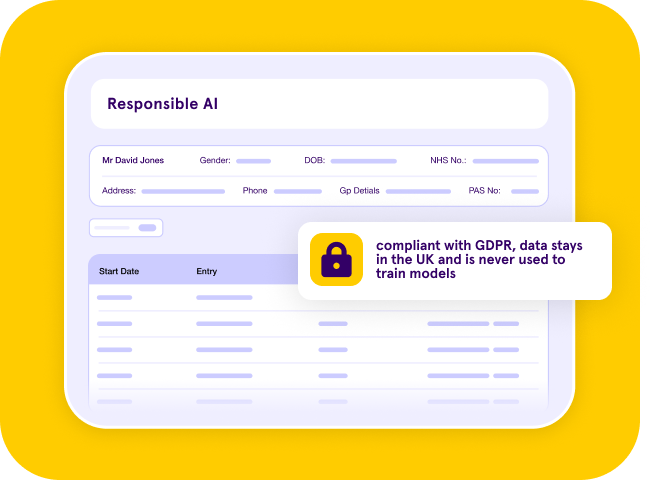
Most providers start with free tools or personal licences, where data is usually processed in the US. Even getting processing within the EU is hard. Because Log my Care runs AI on the same UK infrastructure where your data already sits, it stays in the UK.
Asked from the floor whether provider data trains AI models, Sam explained that the models now analyse and interpret so well that training on live care data isn't needed for strong results, and our manifesto commits that your data is never used to train models.
AI-powered Care Plan Audits: Built with providers in the room
Our customer advisory board meets every quarter to review what we've released and shape what comes next. Our AI-powered Care Plan Audits tool came straight out of that process. It reviews every care plan across a service and gives each one a quality and compliance score that teams can use to improve over time. The board helped define what a useful score looks like, then beta-tested it before wider release.
Garmon explained why that matters to providers.
"Far too often suppliers build what they think we want, not what we actually want." - Garmon Davies
He also put the time saving in plain numbers. Ten people in a home, ten care plans each, and a 25% sample to audit adds up to a lot of preparation for every quality visit. Asking the system what's going on and what the trends are frees that time for supporting people.
Start with the suppliers you already have
Katie's most practical tip: talk to your existing software providers about their AI roadmaps before reaching for anything new. Established care technology suppliers work under far more scrutiny than free online tools, and most will be glad to share their plans. Knowing what's coming helps you set your own direction.
These are the questions from our manifesto checklist to put to any tech partner:
If a supplier can answer all six clearly, you have a strong basis for your own governance evidence.
What's coming next
Asked to look beyond care planning, the panel described a sector moving from recording care to anticipating it.
Preventative care from connected data. Sam has seen continuous health monitoring as the next step since Log my Care started in 2017. We're now working on bringing data from wearables, such as heart rate, movement and sleep, securely into the platform. Pair that with everything already in someone's care plan, and AI can flag changes in day-to-day trends well before they become a crisis.
"It's not that far away, frankly, but I'm super excited about it." - Sam Hussain
Personalised training and companionship. Vishal pointed to AI avatars that let staff practise conversations with someone living with dementia, and voice AI that can offer companionship and pick up early signs of change. His test for innovation in AI was simple: does it improve outcomes? If it doesn't, then question the value it will bring to your service.
Technology that speaks your team's language. Katie focused on what this means for the workforce. Social care staff have exceptional interpersonal skills, and AI is becoming conversational. Instead of learning a new system at every job, staff can ask for the information they need and get it.
"Isn't that an incredibly empowering place for staff to be, where they can ask the question and get the information they need?" - Katie Thorn
Garmon summed up the near-term promise: AI that reaches the data wherever it sits and brings it forward in a way people trust, so everyone, whatever their role, spends more time on the work and less on the admin.
A transformational moment for the sector
Matt closed by calling this a transformational moment for the sector, and an opportunity that has to stay focused on outcomes: for the person receiving care, for the person providing it, and for the organisation.
"I'd really like the five of us to sit here next year and do the same session, because I think we'd be in a completely different space." - Matt Russell
Read our AI manifesto to see the principles we build to, and the standards in AI innovation we hold ourselves accountable to. If you'd like to see AI Care Plan Audits in action, book a demo.