
When you're responsible for multiple care sites, visibility isn't a nice-to-have, it's essential.
Whether you're trying to spot a trend before it becomes a problem, demonstrate performance to stakeholders, or simply feel confident that your services are running well when you're not around, the right data needs to be in the right hands at the right time.
We've built three ways to access and report on your data at a group level, because we know that different services operate very differently.
Integration with Microsoft Power BI
If your organisation already uses Power BI, you can plug straight in. You'll get full access to your own data at an individual site level, with the ability to roll that up into group-level reporting fitting neatly into the tooling and workflows you've already invested in.
Open API
For services with technical teams who want to go further, our open API gives you real-time access to your data. Build custom reports, integrate with other systems, or create whatever tooling is most useful for your service. The data is yours, and the API gives you the flexibility to use it however you need.
Our Native Insights Dashboard
This is the one we're most excited about.
Not every organisation has a data team, and not every group manager wants to build reports from scratch. What they do need is clear. A reliable view of what's happening across their services without having to ask for it, chase it down, or interpret it themselves.
That's exactly what our group-level insights dashboard is designed to deliver.
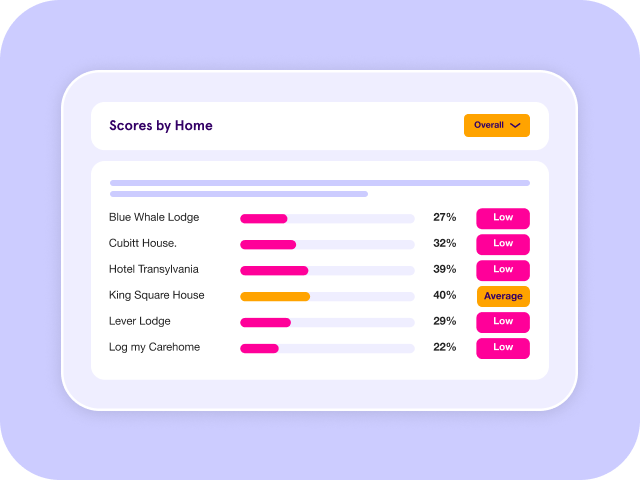
At the top level, you'll see the most important operational and care outcome data for your entire service; whether that's a regional cluster of sites or your organisation as a whole. Each high-level reporting tile is a starting point, not an endpoint. You can drill down into any of them to understand what's happening at site level, giving you both the overview and the detail when you need it.
We've been deliberate about what we include. Drawing on what we've learned from our customers, we've focused on the metrics that actually matter, the ones that reflect real outcomes and real trends and we've aligned the dashboard to CQC reporting and regulation so that what you're looking at maps directly to the questions you'll be asked about your services.
The design principle throughout has been ensuring the experience is intuitive. You shouldn't need to be a data engineer to understand what your service is telling you. This dashboard is built for the people running and overseeing care, not for analysts.
The result is something we hope becomes your hub for insight and oversight. A place where you can monitor performance, identify when to intervene, and report confidently to stakeholders, all without requiring any additional investment or technical resource on your side.
When you're not co-located with your teams, that confidence matters. You should be able to trust that your services are running as they should and know quickly when they're not.
Incident reporting: From trend to action in one place
Incidents are one of the most critical areas to have visibility across a multi-site service. Not just knowing that something has happened, but understanding the pattern, the cause, and what's being done about it. Turning oversight into genuine accountability.
Our group-level incident reporting is built around exactly that journey.
At the top level, you can see incident trends across your services over time; whether incidents are increasing, decreasing, or clustering in particular areas. But a trend line on its own isn't enough. With a single click, you can move from that high-level view into the specifics: what kind of incident occurred, the context around it, and the detail behind it.
From there, the navigation goes further. You can jump directly into the individual case itself, seeing follow-up actions, progress, and reflections all in one place. No switching between systems, no chasing updates. Everything you need to understand what happened and what's being done about it is right there.
This is something we've thought hard about. It's easy to build reporting that tells you how many incidents have occurred. What's harder and more valuable is building something that helps you understand why, and helps you and your teams focus on outcomes and learnings rather than just the numbers. That's what we've tried to do here.
For group managers who aren't on-site day to day, this means you can move from a birds-eye view of your services to a person-centred, specific case that needs your attention fluidly, quickly, and without losing the thread of why you were looking in the first place.
Customisability: Flexibility without losing the thread
There's a version of customisability that sounds like a feature but is actually a symptom.
When a platform lets you customise almost everything, it's worth asking why?
Is that flexibility quietly signalling that your platform hasn't done the hard work of understanding what you need in the first place?
This is a tension that tech providers across industries have grappled with. As Intercom's (a leading tech platform) have argued, the most meaningful flexibility comes not from giving users infinite customisation, but from deeply understanding their workflows and building tools that fit them. Customisation that fills gaps in a product's thinking creates complexity without creating value.
We've seen this play out directly in the care sector.
Many of the services moving to Log my Care from other systems tell us the same thing: their reporting is broken. The reason, more often than not, is hyper-customisability.
When everything can be configured differently at every site, individual data points can't be linked, rolled up, or compared. You end up with a case-by-case view of your service, sifting through individual records to form your own picture, rather than having that picture surfaced for you. Oversight becomes a manual job.
Our approach is different. We want to give you the flexibility to run your service well, not the flexibility to compensate for tools that don't work.
That means configurability where it genuinely matters: the ability to adapt to the specific needs of your service and the people you support, within a structure that keeps your data connected and reportable. Because structured data is what makes everything else in this blog possible. It's what allows you to see trends at a group level, drill into a specific site, and navigate from an incident overview to an individual case without losing the thread.
It also means we take seriously our responsibility to listen. The care sector doesn't stand still. Regulation evolves, service models change, and what you need from a platform today may not be what you need in twelve months. Rather than handing you a blank canvas and asking you to solve that problem yourself, we're committed to continuously developing the features and products that respond to those changes, informed by what we hear from you.
The goal isn't a platform you can make look like anything. It's a platform that already understands what you're trying to do, and gives you the tools to do it well, in a way that keeps your data meaningful, your reporting coherent, and your oversight intact.
Want to find out more and see for yourself how we're doing group level reporting? Book a demo with the team.