

2026 is shaping up to be another year of significant change for the Care Quality Commission (CQC).
In October, the Care Quality Commission shared its initial ideas for the New, New CQC Framework (CQC Framework 2.0?) through its formal consultation. Alongside this, further information was shared by Chris Badger, Chief Inspector of Adult Social Care, on 3 December.
We’ll be unpacking this in much more detail during our webinar, The CQC download, on 5 February, but in this blog, I want to focus on one key question I’ve been asked repeatedly: What will happen to the CQC Quality Statements?
Why were Quality Statements introduced in the first place?
The Quality Statements were introduced as part of the Single Assessment Framework, and the real benefit they brought was breaking the Key Questions - Safe, Effective, Caring, Responsive and Well-led - down into clearer areas of assessment.
Before this, providers were expected to navigate 300+ KLOE prompts, which simply wasn’t manageable in practice. CQC introduced 34 Quality Statements to bring more structure and clarity.
However, one of the strongest themes to come out of the Care Providers Alliance review of the Single Assessment Framework was that 34 Quality Statements felt like too many, and that there was significant overlap between them.
CQC’s initial direction: fewer statements, less overlap
CQC made it clear that they intended to reduce the number of Quality Statements and cut down on duplication. We then waited through much of 2025 to see what that would look like in reality.
When the consultation was published in October, however, it appeared that things had moved in a different direction.
The October consultation surprise: Supporting Questions instead?
CQC’s current proposal is to:
- Reintroduce ratings characteristics (what Outstanding, Good, Requires Improvement and Inadequate actually look like), and
- Have these ratings characteristics underpinned by “Supporting Questions”, which would effectively replace Quality Statements.
I think I speak for much of the sector when I say this came as a surprise - particularly as no examples of what a Supporting Question actually is were provided.
Another twist: December’s update - the reappearance of Quality Statements?
That wasn’t the end of it.
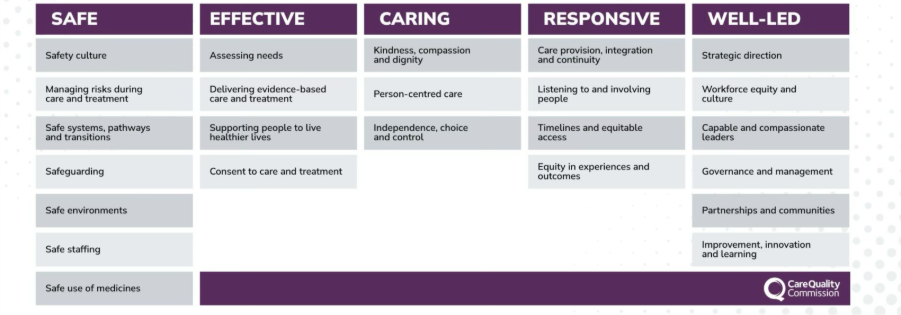
On 3 December, Chris Badger shared a list of what looked very much like 24 Quality Statements.
What stood out:
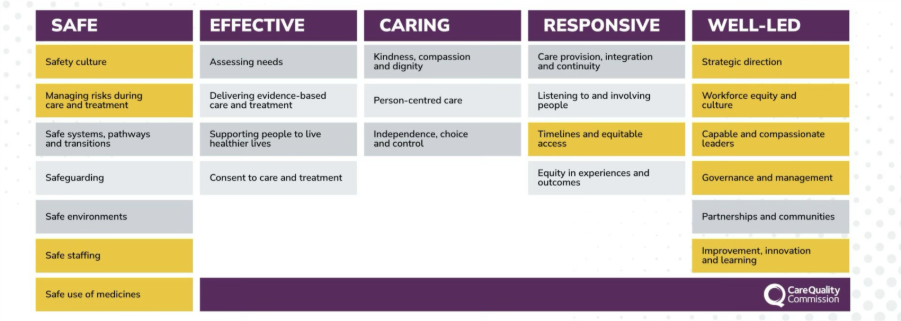
- 14 of the 24 are exactly the same as existing Quality Statements
- The remaining 10 involve only minor wording changes
- Person-centred Care has moved from Responsive to Caring
It’s also worth noting what’s missing. Environmental Sustainability and Workforce wellbeing and development have disappeared. One possible reason is that these two areas were felt to have a less clear regulatory basis, with questions raised about whether CQC had the authority to assess them.
So, what does this mean for providers?
First: don’t panic
CQC has been clear that the framework is unlikely to be fully rolled out until the end of 2026.
If you’re inspected in the next six months (at time of writing), you will almost certainly still be inspected under the Single Assessment Framework and its 34 Quality Statements.
Second: expect evolution rather than removal
It’s likely that the ratings characteristics will be organised under these 24 areas. In other words, instead of a single Quality Statement sentence, we may see more detailed expectations sitting beneath each area.
Finally: keep listening for updates
The key thing over the coming months is to stay close to CQC updates as the picture continues to evolve.
At Care Research, we’re working closely with Log my Care to ensure providers receive clear, practical updates and understand how to prepare effectively.
👉 Our webinar, The CQC download, on 5 February is an excellent opportunity to hear the latest thinking, ask questions, and understand how to keep your service CQC-ready as the framework continues to evolve.